


Market highlights
- Six crypto wallets dormant since 2011–2014 transfer US$40 million of bitcoin in August.
- U.S. Government expanded sanctions to cover anyone operating in Iran's crypto sector.
- AI-assisted researchers discovered a critical vulnerability in Bitcoin's Core Lightning Network.
- ETH developers proposed new validator contract to prepare for post-quantum cryptography.
- Thirty-nine U.S. state banking associations have organised to build bank-owned blockchain.
- UK Treasury to give Bank of England statutory objective to promote stablecoin innovation.
Macro market overview
U.S. risk assets ended the week higher as investors balanced strong technology earnings against persistent inflation and renewed expectations of further Federal Reserve tightening. Last week's decision by the U.S. Treasury to double long-dated bond buybacks continued to influence markets, although Treasury Secretary Scott Bessent confirmed on Monday that regular debt auctions would continue and the expanded repurchases will not commence until September 10. Long-dated yields have since reversed much of their initial post-announcement decline. In contrast, gold climbed to a three-month high on Tuesday, August 25, hitting almost US$4,700 an ounce as the dollar weakened on the Treasury's bond buyback announcement.
Economic data provided little relief on inflation. The Fed's preferred personal consumption expenditures (PCE) index increased 3.7% year-on-year in July, unchanged from June and above the 3.6% forecast. Second-quarter U.S. GDP growth came in on forecast at an annualised 1.5%. At Jackson Hole on Friday, August 26, Fed Chair Kevin Warsh said policymakers would have "more work to do" unless inflation showed clear progress towards the Fed's 2% target, lifting expectations of a September 16 rate hike. CME's FedWatch tool currently puts the likelihood of a rate hike at 65.4%.
In the Middle East, diplomatic efforts to restore shipping through the Strait of Hormuz intensified, with Iran, Oman and Qatar discussing conditions for normalising traffic. Over the weekend, the U.S. and Iran each launched strikes for the first time in a month, leading to a 2.3% jump in oil prices to start the week.
Looking to the week ahead, market participants will presumably monitor developments in the Middle East, the U.S. ISM manufacturing PMI, U.S. August non-farm employment change, and further information about the Fed's direction for its September 16 meeting.
Weekly performance: S&P 500 +0.7%, Dow Jones +0.5%, Nasdaq +0.5%.
Looking ahead:
- U.S. ISM manufacturing PMI - Wednesday, September 2
- U.S. August non-farm employment change - Friday, September 4
Crypto Market Performance
Market Cap: $2.64T (+0.6%)
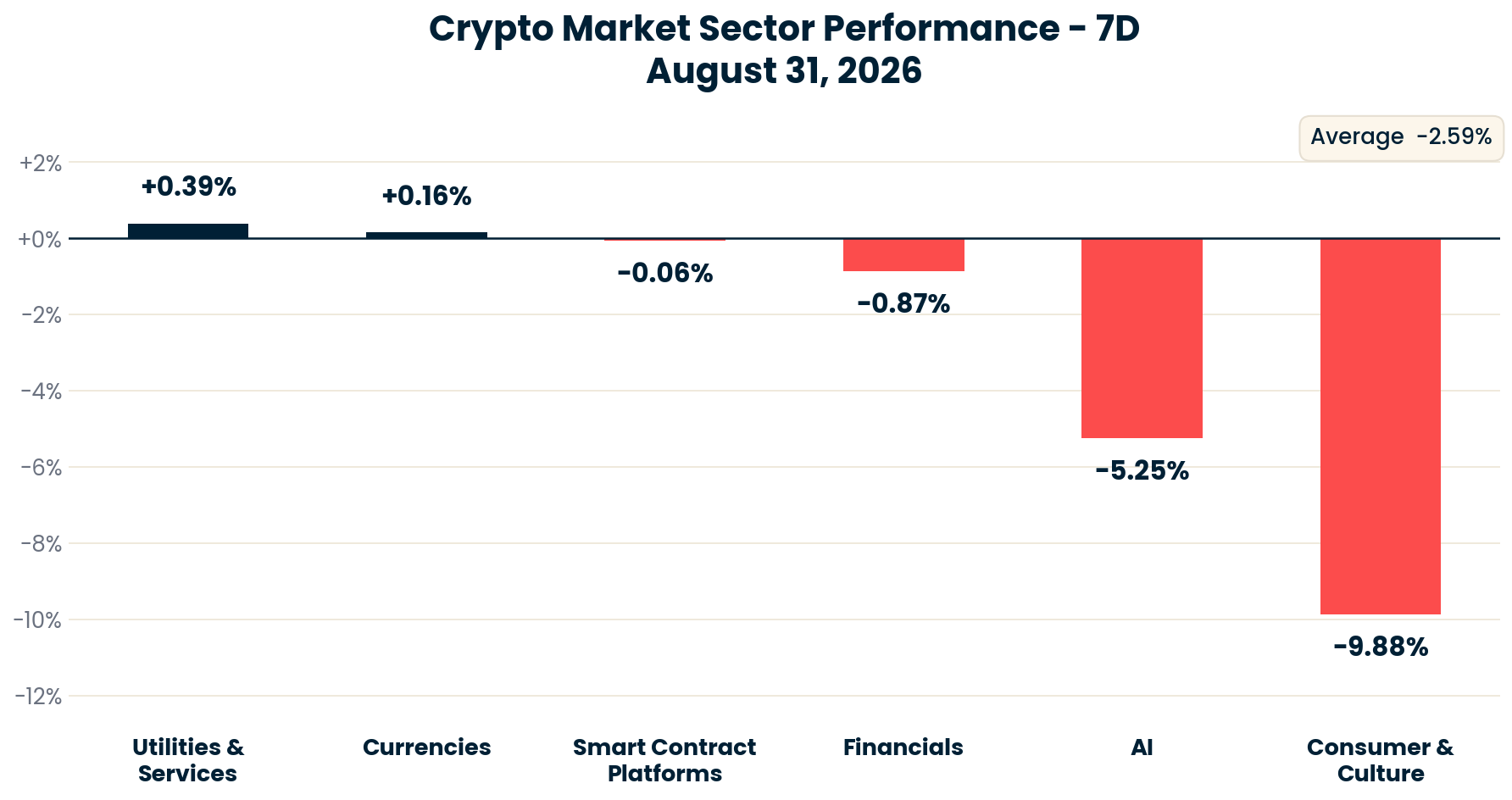
Crypto performance was subdued this week, as rising geopolitical and macroeconomic uncertainty saw last week's momentum slow. Consumer and culture saw the steepest declines, while much of the market traded flat. Market participants are presumably awaiting further certainty around the Fed's September 16 interest rate decision, developments in the bond market and Middle East and how the U.S. dollar and other assets respond. The crypto fear and greed index is currently in "greed" at 75.
Past performance is not a reliable indicator of future results.
Bitcoin (BTC)
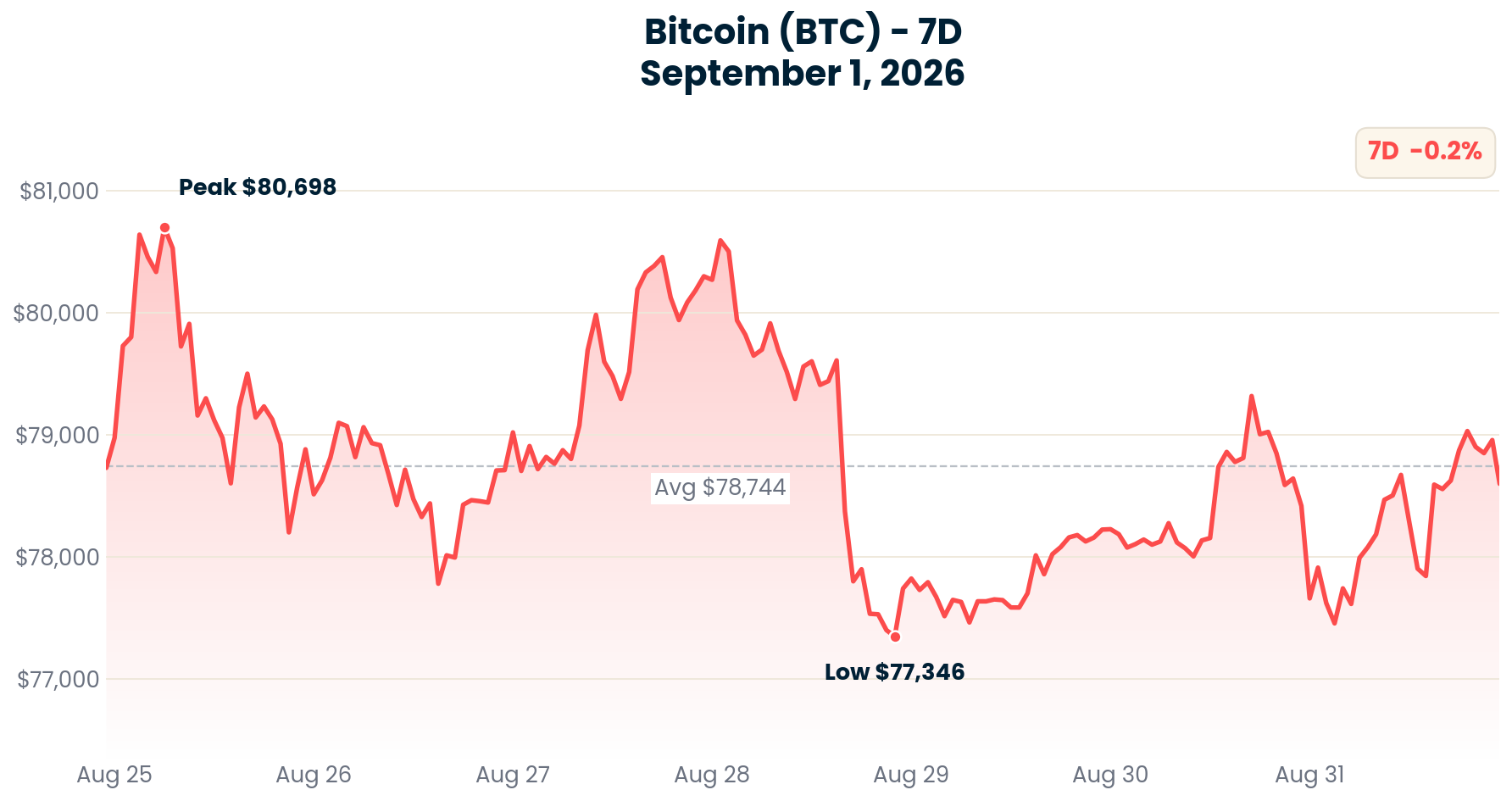
- Opened the week at US$77,724 and gained to a weekly high of US$81,455 on Friday, August 28 before declining, presumably due to the US$6.44 billion Deribit options expiry, anticipation of a September rate hike by the Fed and escalating Middle East tensions. Bitcoin traded flat into the new week and is now trading around US$78,600 (-0.2% 7D).
- BTC dominance ranged between 59.2% and 60.3% this week.
- Bitcoin investment products saw inflows of US$924.5 million.
Bitcoin's oldest coins are moving at an unusually high rate in 2026. Throughout August, six wallets dormant since 2011–2014 transferred 553.59 BTC worth about US$40 million. Galaxy Research says decade-old coins are reactivating faster than most previous years, potentially driven by litigation and security concerns following the Coldcard exploit.
AI-assisted researchers discovered a critical vulnerability in Bitcoin's Core Lightning Network that could let attackers steal funds from channels under specific conditions. Developers issued an emergency warning and urged node operators not to shutdown their node and to update the affected software immediately. The company suggested that users don't shutdown their node as, in the case of another participate forcing a channel to close, the node can respond.
In bitcoin buying (and selling) news:
- Strategy bought 4,603 BTC (US$370 million), bringing its holdings to 845,050 BTC (US$63.7 billion) at an average purchase price of US$75,412 per bitcoin.
Past performance is not a reliable indicator of future results.
Ethereum (ETH)
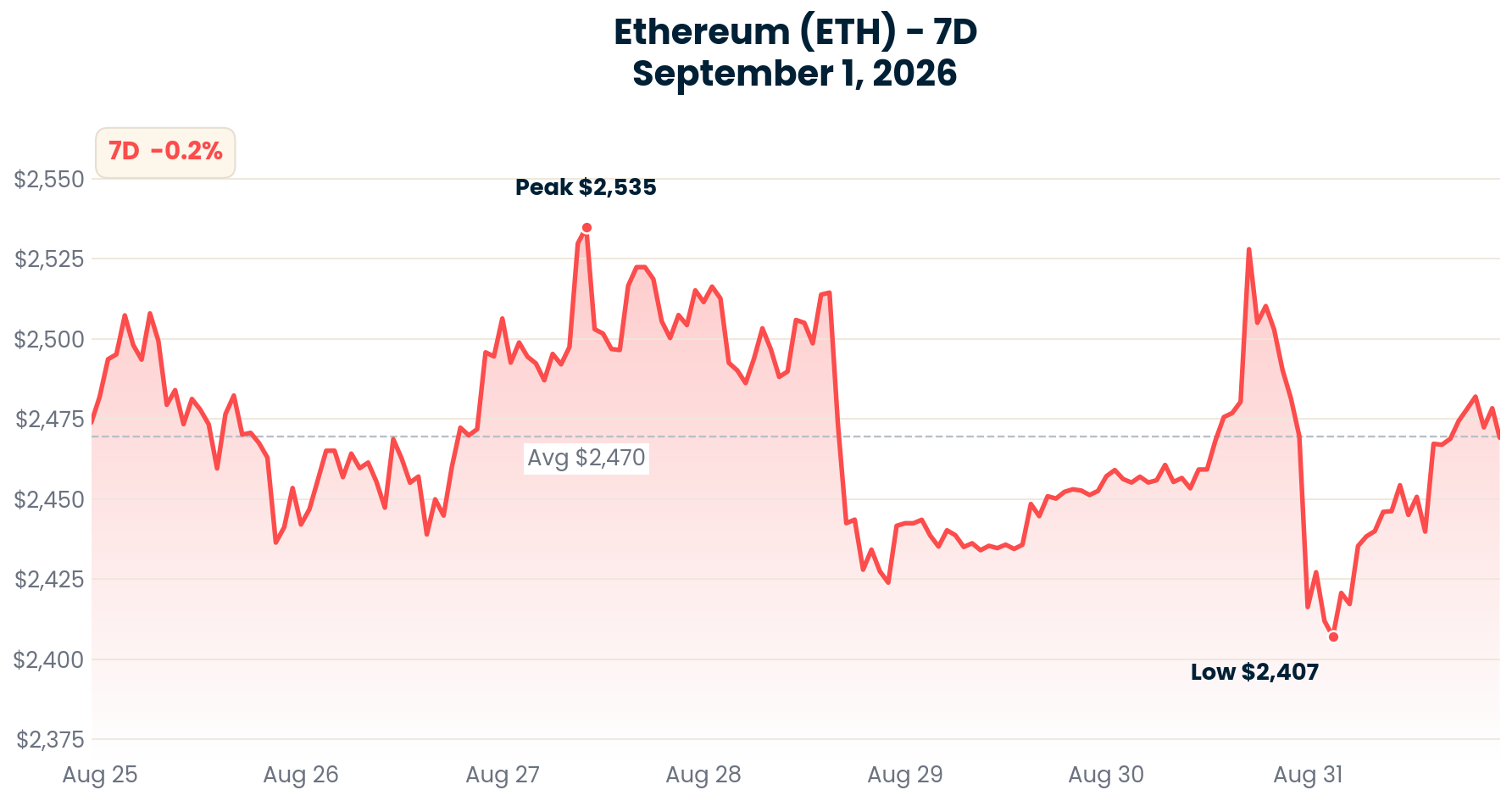
- Opened the week at US$2,463 and gained to a weekly high of US$2,566 on Thursday, August 27 before retreating on growing macroeconomic and geopolitical uncertainty. Ethereum declined into the new week, and is now trading around US$2,470 (-0.2% 7D).
- Ethereum dominance ranged between 11.2% and 11.5% this week.
- Ethereum-focused funds saw inflows of US$815.7 million.
Ethereum developers proposed replacing the network's validator deposit contract to prepare staking for post-quantum cryptography. The draft would support validator keys up to 8,192 bytes and enable Ethereum to permanently retire today's BLS signatures. The proposal remains preliminary, with post-quantum cryptography, deployment details and activation dates still undecided. If approved, the proposal would require a coordinated fork across both layers.
In Ethereum buying news:
- BitMine bought 53,501 ETH (US$131.1 million). The company now holds almost 5.9 million ETH, worth US$14.8 billion, or around 4.9% of supply.
Past performance is not a reliable indicator of future results.
Altcoins
The altcoin season index is currently 25, which is bitcoin season.
Stellar news
- VeChain gained 20%. The supply chain management chain gained on broader crypto risk appetite and anticipation of its Interstellar upgrade, scheduled for September 16. The upgrade improves EVM compatibility through new opcodes and cryptographic features. VET also broke a multi-month downtrend, attracting increased trader attention.
Decent proposal
- Solana gained almost 8%. The gains came as validators approved the "Double Disinflation" proposal, doubling the annual reduction in SOL issuance from 15% to 30%. The change brings Solana's 1.5% inflation floor forward to 2029 from 2032, eliminating an estimated 18.9 million SOL in issuance over six years, but reducing staking yields.
Rough patch
- Polygon declined by 11.6%. This week, the layer-2 scaling network disclosed that it quietly patched multiple security vulnerabilities through its Austin and Kyoto hard forks before revealing them publicly. The flaws included denial-of-service risks and a vulnerability allowing attackers to impose costly workloads across validators. Polygon said none were exploited, and both upgrades are now mandatory for node operators.
Crypto ETF News
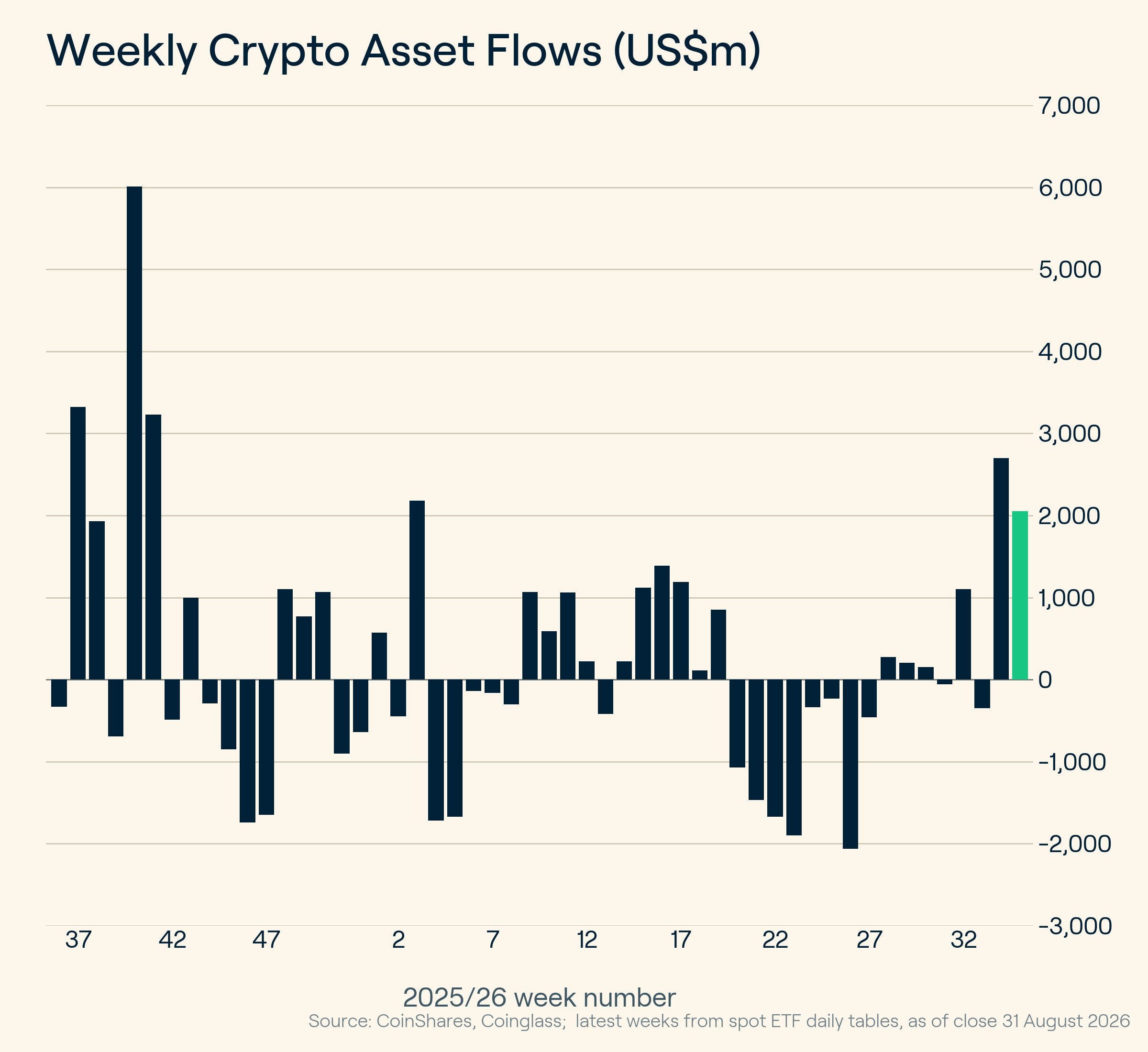
Digital asset investment products saw inflows of almost US$2 billion for the week as the bullish sentiment from last week continued.
In altcoins, XRP, Solana and HYPE saw inflows of US$110.5 million, US$142.7 million, and US$56.8 million, respectively.
Grayscale launched ZCSH, the first spot Zcash exchange-traded product, on NYSE Arca. The launch follows Zcash's Ironwood upgrade, which replaced its vulnerable shielded pool after researchers discovered a flaw enabling counterfeit ZEC creation.
Past performance is not a reliable indicator of future results.
Other crypto news
- Thirty-nine U.S. state banking associations formed the BankChain Alliance to build a shared, bank-owned blockchain network for community and regional banks. Targeting a 2027 launch, it could support tokenised deposits, stablecoins, programmable payments and automated settlement. The alliance has not yet selected its technology provider or finalised its architecture.
- The U.S. Government expanded sanctions authorities to cover anyone operating in Iran's cryptocurrency sector, following an executive order from President Trump. Treasury can now target exchanges, miners, wallet providers and other crypto businesses linked to Iran, aiming to restrict Tehran's access to digital assets for sanctions evasion and financing.
- The Blockchain Association urged U.S. regulators to limit stablecoin identity checks to direct issuer-customer relationships under the GENIUS Act. It argued know your customer (KYC) requirements should exclude peer-to-peer transfers, one-off redemptions and technology providers, while allowing issuers to rely on regulated institutions and modern digital identity tools for customer verification.
- Evernorth Holdings moved closer to becoming the largest publicly traded XRP treasury company after the U.S. Securities and Exchange Commission declared its registration effective. Shareholders will vote September 30 on its merger with Nasdaq-listed Armada. Evernorth spent roughly US$947 million on XRP last October.
- Charles Schwab plans to add Solana, Avalanche and Chainlink trading to its Schwab Crypto platform in coming months, expanding beyond Bitcoin and Ethereum. Clients will trade through Schwab's website, app and thinkorswim platform for a 0.75% fee. Direct bitcoin and Ethereum trading began rolling out in May.
- The UK Treasury will give the Bank of England (BoE) a secondary statutory objective to promote innovation in payments and digital money, including stablecoins. The amendment requires annual reporting to Parliament while keeping financial stability paramount. It follows the Bank scrapping individual stablecoin holding caps and reducing zero-interest reserve requirements. The bill to give the BoE this added responsibility will reach the House of Lords in September.
- European Central Bank board member Piero Cipollone said a digital euro would provide maximum technological privacy. Offline transactions would be visible only to participants, while the Eurosystem could not identify parties to online payments, although commercial banks could. A 12-month pilot is planned for 2027, with issuance targeted for 2029.
- Galaxy launched its Crypto Portfolio Line of Credit for eligible U.S. GalaxyOne clients, allowing them to borrow against their bitcoin, Ethereum and staked Solana without selling. The revolving facility offers a variable 8.99% APR, 50% loan-to-value ratio and no origination fee, while pledged crypto is not rehypothecated.
from Caleb & Brown Cryptocurrency Brokerage.


