


Market highlights
- The FBI blamed North Korea for the more than US$6 billion Binance hack, the largest on record.
- NYSE owner ICE agreed to bring Hyperliquid-based perpetual futures to U.S. users, pending approval.
- DTCC launched its tokenisation service, with 20 banks and brokers signed up.
- The OCC gave Ripple final approval to open a national trust bank.
- CFTC Chair Michael Selig blamed "unregulated offshore exchanges" after the Binance hack.
- Tether reported a US$1.5 billion third-quarter profit as its excess reserves nearly doubled.
Macro market overview
U.S. markets ended lower as doubts over artificial intelligence (AI) spending returned to technology shares, with the S&P 500 and Nasdaq falling for a third straight week. Alphabet fell almost 13% on Thursday, its worst day since it listed in 2004, after heavier data centre spending kept its free cash flow negative for a second straight quarter, while Intel fell nearly 30% on Friday, its worst day in more than 50 years, after a weaker-than-expected forecast. The Nasdaq ended October with its worst month since March 2025, and the sell-off in chip stocks continued into the new week.
The U.S. Federal Reserve held rates at 3.75%–4% in a 10–2 vote, with Governor Lisa Cook and Cleveland Fed President Beth Hammack preferring a hike, while Chair Kevin Warsh gave little guidance on December. Third-quarter GDP grew 3.4% against a forecast 3.1%, and the core personal consumption expenditures (PCE) index rose 3.1% from a year earlier in September, in line with forecasts. The 10-year Treasury yield ended the week at 4.94%, down from 5.00%. CME's FedWatch tool now puts the likelihood of a rate hike at the Fed's December 9 meeting at 76.6%, down from around 84% a week ago.
Oil prices swung sharply into the new week. Brent crude fell 7.6% to US$104.77 a barrel on Monday as Washington and Tehran signalled openness to a diplomatic solution. It rose early the next day after reports of a U.S. strike on Iran's Qeshm Island, then settled US$1.17 lower at US$103.60 amid talk of progress towards a U.S.–Iran deal. Elsewhere, the Reserve Bank of Australia (RBA) raised the cash rate by 25 basis points to 4.85% in a 6–3 vote, while the European Central Bank and the Bank of Japan held rates.
Looking ahead, market participants will be watching the results of Tuesday's U.S. midterm elections, in which crypto industry political groups spent nearly US$170 million. Close races could take days to call.
Weekly performance: S&P 500 -0.6%, Dow Jones -0.9%, Nasdaq -2%.
Looking ahead:
- Bank of England rate decision - Thursday, November 5
- U.S. non-farm employment change - Friday, November 6
- U.S. CPI - Tuesday, November 10
Crypto Market Performance
Market Cap: $2.59T (-3.1% 7D)
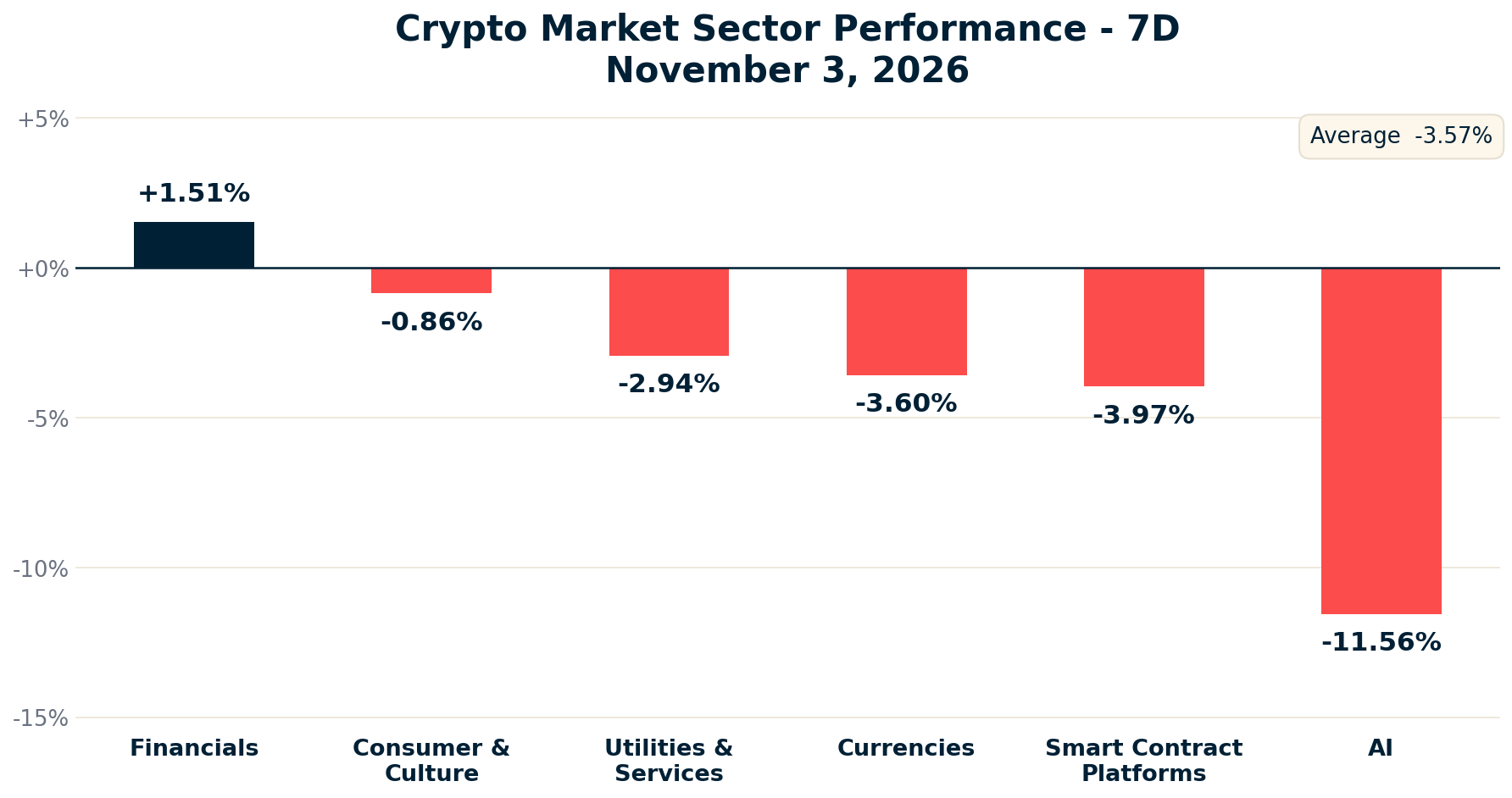
Five of six crypto sectors declined this week, coinciding with the Binance hack and a sell-off in chip stocks. Financials led with a 1.5% gain as Hyperliquid rallied, followed by consumer and culture, which slipped 0.9%, while AI lagged with an 11.6% decline, coinciding with the sell-off in AI-linked shares. The crypto fear and greed index has fallen into "fear" at 34, down from 44 a week ago.
Past performance is not a reliable indicator of future results.
Bitcoin (BTC)
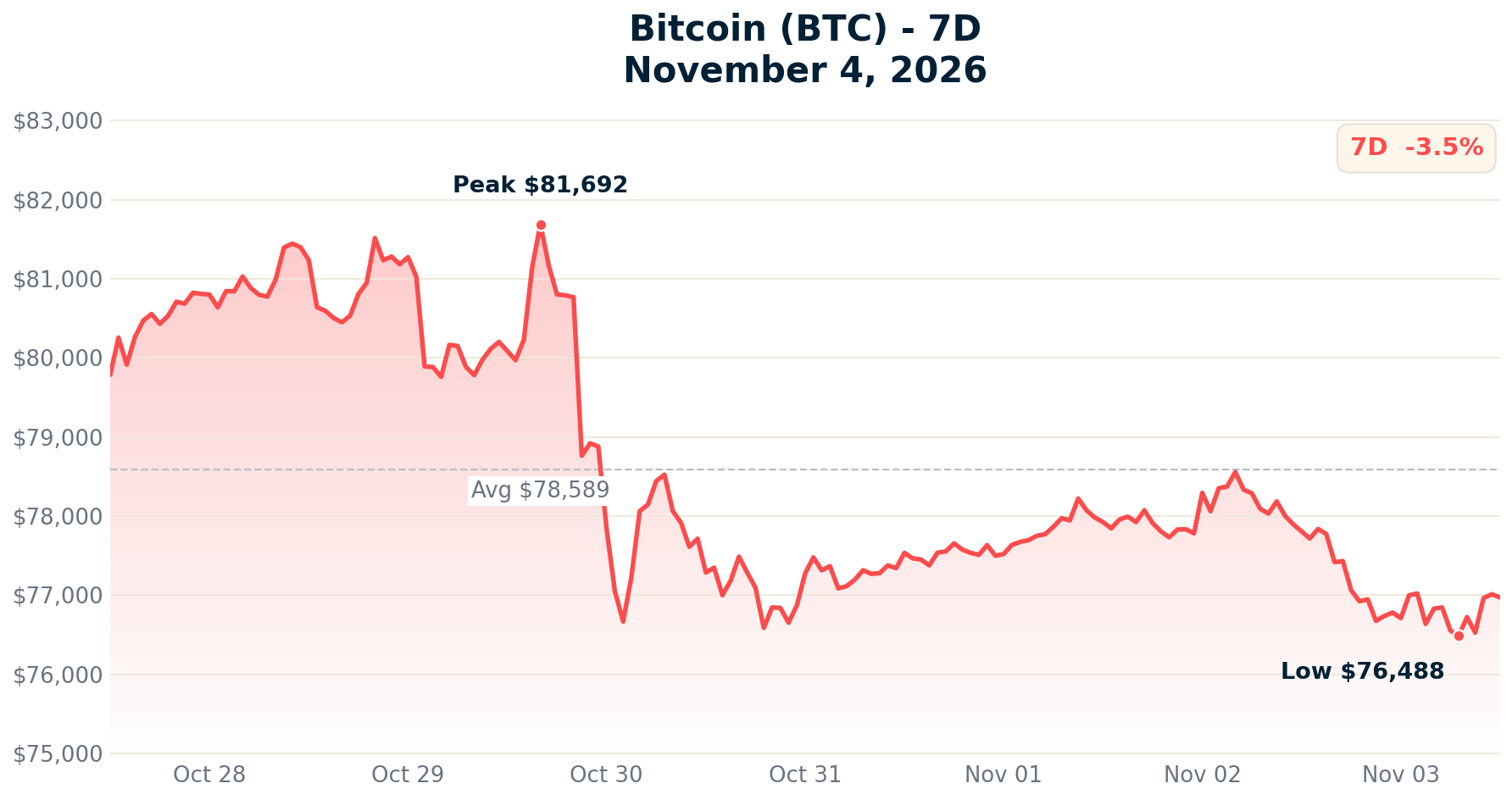
- Opened the week at US$79,787, climbed to a weekly high of US$81,692 on Thursday, October 29, then declined after the Binance hack, coinciding with a sell-off in chip stocks. Bitcoin fell to a weekly low of US$76,488 on Tuesday, November 3 and is now trading around US$76,971 (-3.5% 7D).
- BTC dominance ranged between 59.6% and 60.2% this week.
- Bitcoin investment products saw outflows of US$202.4 million.
Hackers stole more than US$6 billion from Binance on October 29, the largest crypto hack on record and about four times the US$1.5 billion taken from Bybit in February 2025. The FBI attributed the attack to TraderTraitor, a North Korean hacking group, though North Korea denies involvement. Nearly US$3 billion of the stolen funds has been frozen, and Binance says it is covering users' losses from its own funds and has reopened withdrawals.
The stolen funds were spread across about 12,000 wallets on 11 blockchains in under four days, around one new wallet every 25 seconds, potentially to make them harder to trace. Binance also moved about 7,500 BTC out of its emergency user-protection fund, halving the fund's bitcoin balance, which Binance said was part of using the fund to cover the losses.
In bitcoin buying news:
- Strategy bought 811 bitcoin (US$65.5 million), bringing its holdings to 849,327 BTC (about US$65 billion) at an average purchase price of US$75,451 per bitcoin. The company also spent US$208.2 million buying back its STRC preferred shares.
- Strive bought 124 bitcoin (about US$10 million), bringing its holdings to 43,124 BTC (about US$3.3 billion).
Past performance is not a reliable indicator of future results.
Ethereum (ETH)
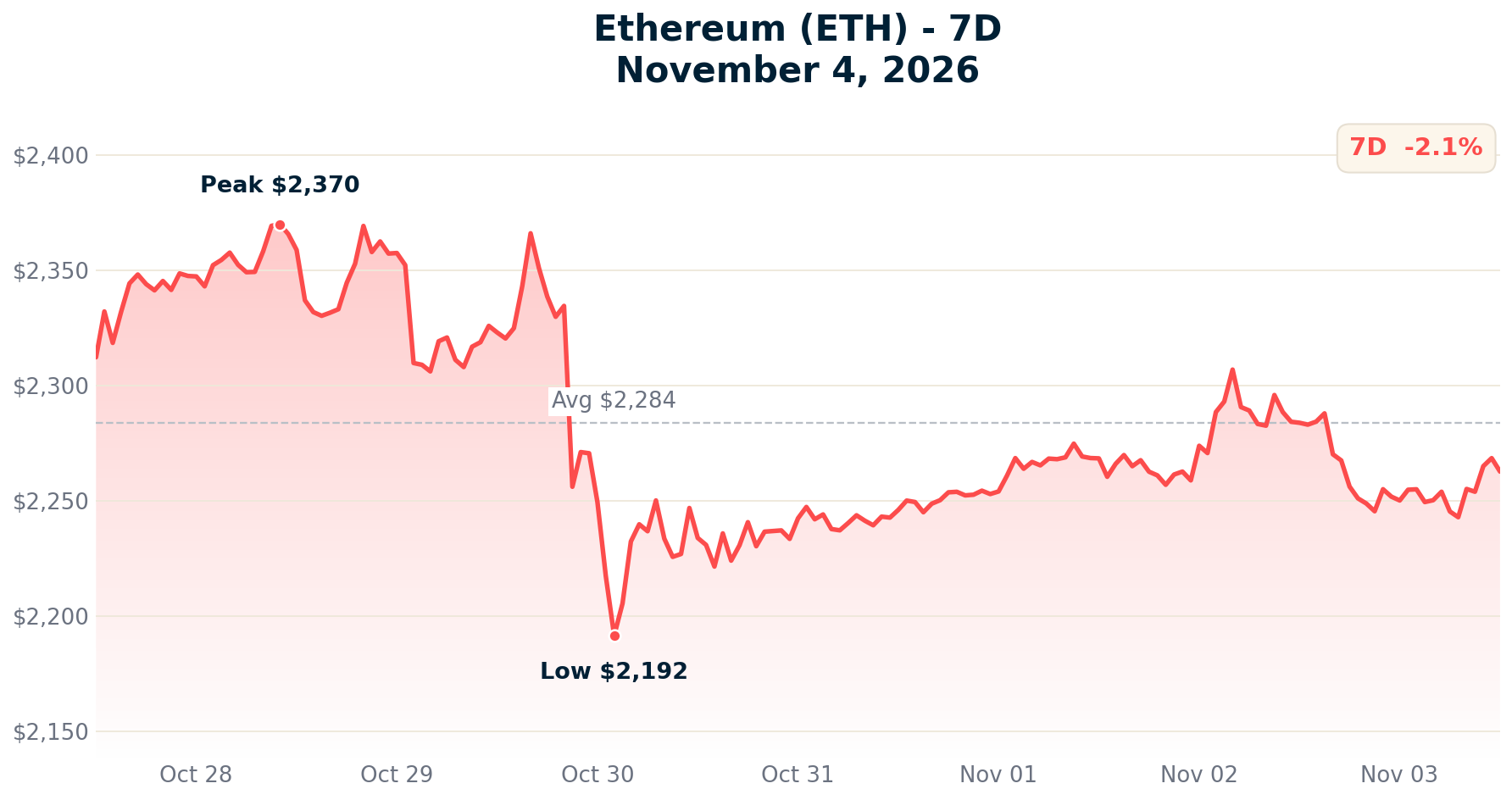
- Opened the week at US$2,312, reached a weekly high of US$2,370 on Wednesday, October 28, then declined after the Binance hack to a weekly low of US$2,192 on Friday, October 30. Ethereum is now trading around US$2,263 (-2.1% 7D).
- Ethereum dominance ranged between 10.4% and 10.7% this week.
- Ethereum-focused funds saw outflows of US$431.4 million.
The Binance attacker used EIP-7702, a feature added in Ethereum's Pectra upgrade that lets an ordinary wallet run smart contract code, to drain one of the exchange's hot wallets to its own addresses. Binance later said the attack began with a fake job interview, after which the hackers used stolen staff credentials to hijack its internal wallet-signing service, pointing to a breach of Binance's own systems rather than a flaw in Ethereum.
On Ethereum layer-2 network Arbitrum, the Security Council used its emergency powers to move about US$30 million of the stolen funds without the hacker's private key. The funds, 8,425 ETH and 74 million ARB, can now only be moved by a vote of Arbitrum's DAO.
In Ethereum buying news:
- BitMine bought 8,573 ETH (about US$19 million). The company now holds over 6 million ETH, worth about US$13.7 billion, or around 4.9% of supply. Over 5.2 million of BitMine's holdings are staked.
Past performance is not a reliable indicator of future results.
Altcoins
The altcoin season index is currently 47, which is near the midway point between bitcoin and altcoin season, though still weighted toward bitcoin season.
Breaking the ICE
- Hyperliquid gained 8.8%. The decentralised perpetual futures exchange rallied after Intercontinental Exchange (ICE), the owner of the New York Stock Exchange, agreed to bring Hyperliquid-based perpetual futures to U.S. users through a deal with TradeXYZ, subject to regulatory approval. ICE will run the new regulated market and its clearing, and is taking a minority stake in TradeXYZ. Also this week, the U.S. Commodity Futures Trading Commission (CFTC) cleared perpetual futures on individual stocks to trade on registered U.S. exchanges for the first time.
Hack and sell
- Ethena declined by 15.6%. The synthetic dollar protocol's token fell after the Binance attacker sold about 217.5 million ENA, worth about US$33.9 million. Ethena's USDe stablecoin briefly slipped to US$0.9974, while minting and redemptions continued.
- Solana declined by 7.6%. The layer-1 network's token fell with the wider market after the Binance hack, and the hackers later began swapping about 487,000 SOL, worth about US$46 million, for bitcoin. Solana-focused funds also saw outflows of US$71.6 million for the week.
Crypto ETF News
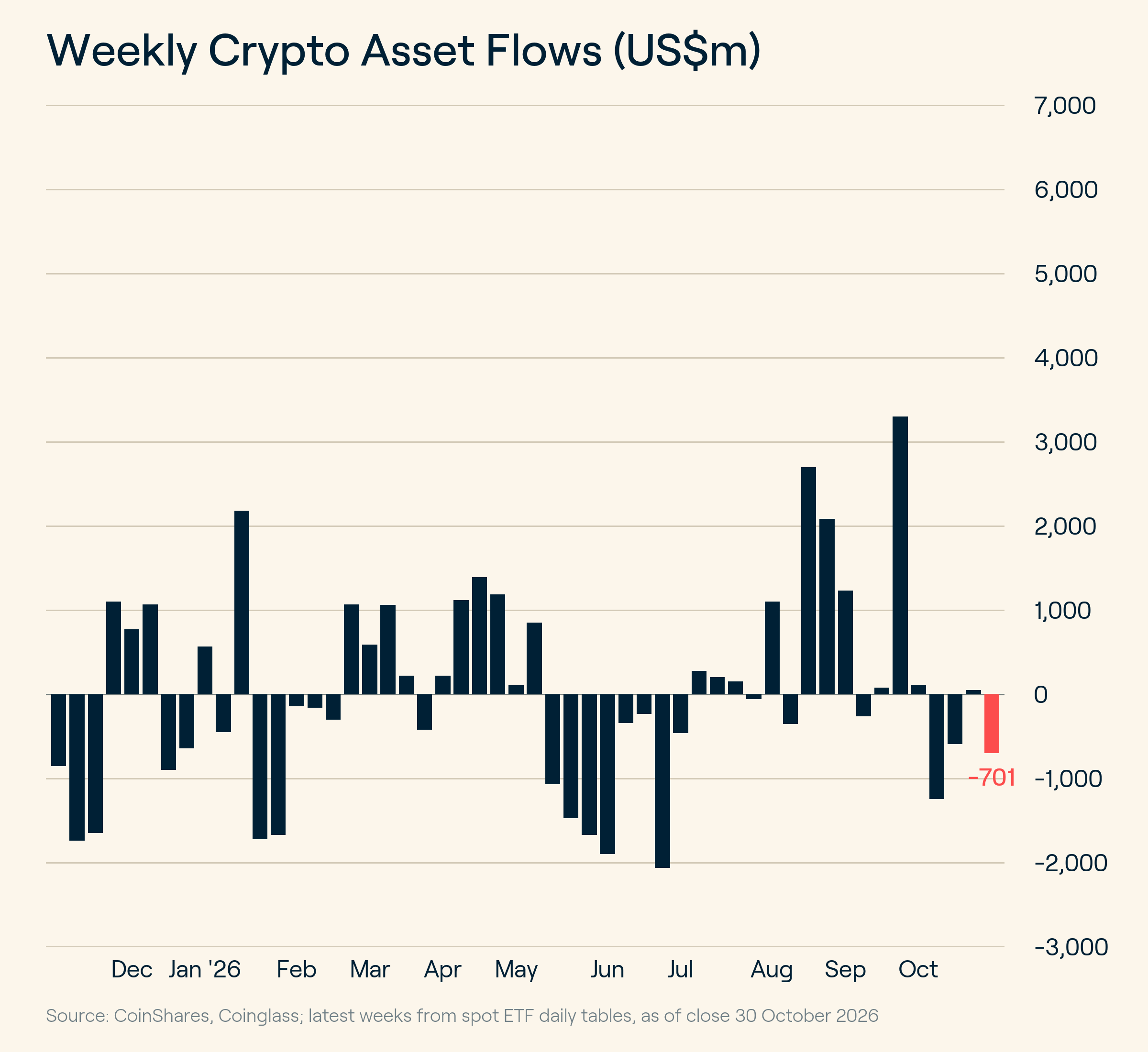
Digital asset investment products saw outflows of US$701.2 million for the week, as US$643.2 million left bitcoin funds on Friday, the day after the Binance hack, more than wiping out their inflows from earlier in the week.
In altcoins, XRP saw inflows of US$4.8 million. Solana and HYPE saw outflows of US$71.6 million and US$0.6 million, respectively.
VanEck launched the Wealth Builder ETF (WBMO) on the NYSE, an actively managed fund that holds stocks, bonds and gold and targets a 2% allocation to bitcoin through a spot bitcoin product.
Past performance is not a reliable indicator of future results.
Other crypto news
- The Office of the Comptroller of the Currency (OCC) gave Ripple final approval to open Ripple National Trust Bank, which will manage the reserves behind its US$2.6 billion RLUSD stablecoin. The approval comes 10 months after the OCC's conditional approval in December 2025. A community bank group is challenging the OCC's crypto trust charters in court.
- Commodity Futures Trading Commission (CFTC) Chair Michael Selig blamed "unregulated offshore exchanges" for the risks exposed by the Binance hack, while industry group the Digital Chamber urged Congress to give the CFTC powers over crypto exchanges before it adjourns. Senator Cynthia Lummis pointed to the CLARITY Act, which has been stalled in the Senate since a 49–50 vote on September 15, as a way to help freeze suspicious transactions.
- The Depository Trust & Clearing Corporation (DTCC), which runs the main settlement system for U.S. securities, launched its tokenisation service, letting firms hold blockchain tokens backed one-for-one by securities in its custody. The service covers 34 securities, including large-cap stocks, exchange-traded funds and Treasuries, and 20 firms including JPMorgan, Citi and Morgan Stanley have signed up. More blockchains are planned for 2027.
- Tether, the issuer of the USDT stablecoin, reported a US$1.5 billion third-quarter profit, as its excess reserves nearly doubled to almost US$8 billion. Its reserves of US$191.5 billion include about US$132 billion of exposure to U.S. Treasury bills and US$8.4 billion of bitcoin.
- The Hong Kong Monetary Authority (HKMA) moved its EnsembleTX tokenised settlement platform to round-the-clock live transactions and plans to add regulated stablecoins. Standard Chartered launched tokenised deposits for corporate clients on the platform, with transfers settled in central bank money.
- Hardware wallet maker Keystone will destroy 18,835 unsold devices and has paused shipping after attackers stole the key its wallets use to prove they are genuine, which could let counterfeits pass its checks. The breach also exposed the details of 25,964 customers, though Keystone says recovery phrases and private keys were not affected.
from Caleb & Brown Cryptocurrency Brokerage.


