


Market highlights
- Weak U.S. jobs data saw markets scale back bets on an October Fed rate hike.
- Bitcoin recorded its best weekly close in eight months after its strongest Q3 since 2017.
- The CFTC proposed a federal framework for regulating crypto exchanges.
- The U.S. Treasury withdrew proposed rules targeting self-custody wallets and crypto mixers.
- OKX and ICE's joint venture filed to offer 24/7 trading of tokenised U.S. stocks.
- Strategy's bitcoin holdings reached a record 848,000 BTC.
Macro market overview
U.S. markets were mixed last week as a sell-off in long-dated Treasuries pushed yields to multi-decade highs, before softer inflation and weak employment data eased expectations of another rate hike. The 10-year Treasury yield reached 5.344% on Thursday, October 1, its highest level since April 2002, and ended the week at 5.28%, while the 30-year yield climbed above 5.6%. The Nasdaq notched a third consecutive weekly gain as artificial intelligence (AI) and mega-cap technology stocks lifted the index to a record close on Monday, while the Dow Jones lagged.
The U.S. core personal consumption expenditures (PCE) index rose 3% year-on-year in August, below the 3.3% forecast, while headline PCE came in at 3.4% versus a forecast 3.7%. On Friday, the September non-farm employment change came in well below forecast at 29,000, versus a forecast 84,000, while the unemployment rate rose to 4.2%. CME's FedWatch tool now puts the likelihood of a rate hike at the Fed's October 28 meeting at 18%, down from around 70% a week ago, though markets continue to price in a hike in December. Closer to home, the Reserve Bank of Australia (RBA) raised the cash rate by 25 basis points to 4.6%, its fourth hike this year.
Middle East developments continued to drive energy markets. Brent crude rose 4.4% to US$102.31 on Thursday following reports of a third U.S. aircraft carrier group heading to the region and further attacks on tankers, before the G7's plan to release 100 million barrels of crude and diesel from reserves capped gains. Brent ended the week little changed at around US$102 per barrel, and eased to US$100.32 on Monday as Middle East crude exports rose back above pre-war levels. Meanwhile, the U.S. dollar index climbed to a 2026 high, while gold fell 3.4% for the week.
Looking ahead, markets will be watching the minutes from the Fed's September meeting for signals on the path of interest rates, alongside this week's Treasury auctions as long-dated yields test multi-decade highs. The September consumer price index (CPI), due on October 14, will be the final major inflation reading ahead of the Fed's October meeting.
Weekly performance: S&P 500 -0.3%, Dow Jones -1.3%, Nasdaq +0.5%.
Looking ahead:
- U.S. FOMC meeting minutes - Wednesday, October 7
- U.S. University of Michigan Consumer Sentiment - Friday, October 9
Crypto Market Performance
Market Cap: $2.93T (+2.2% 7D)
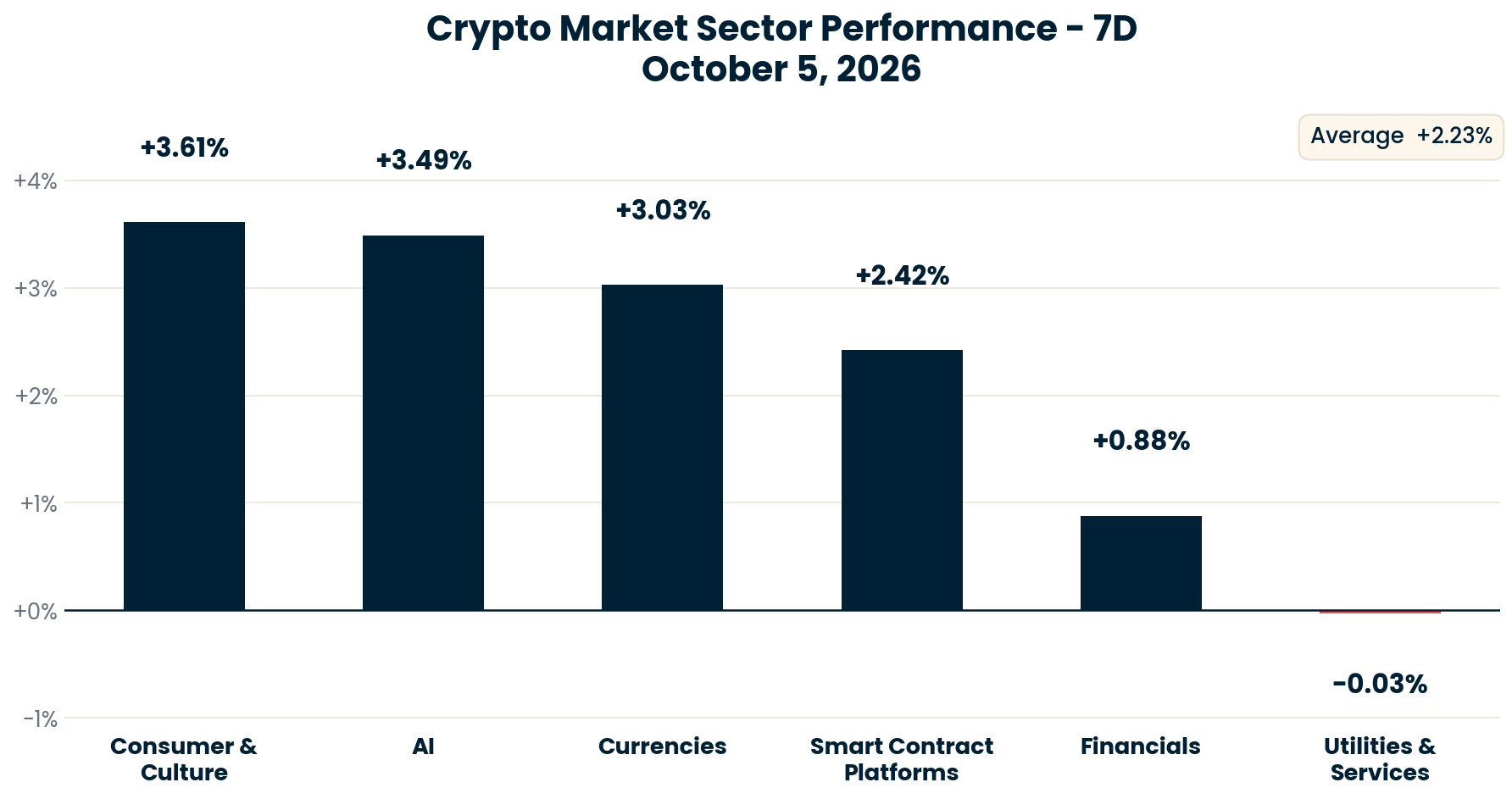
Five of six crypto sectors saw gains this week as weak U.S. employment data eased fears of an October Fed rate hike. Consumer and culture led with a 3.6% gain, followed by AI at 3.5%, while utilities and services was flat. The crypto fear and greed index remains in "greed" at 67.
Past performance is not a reliable indicator of future results.
Bitcoin (BTC)
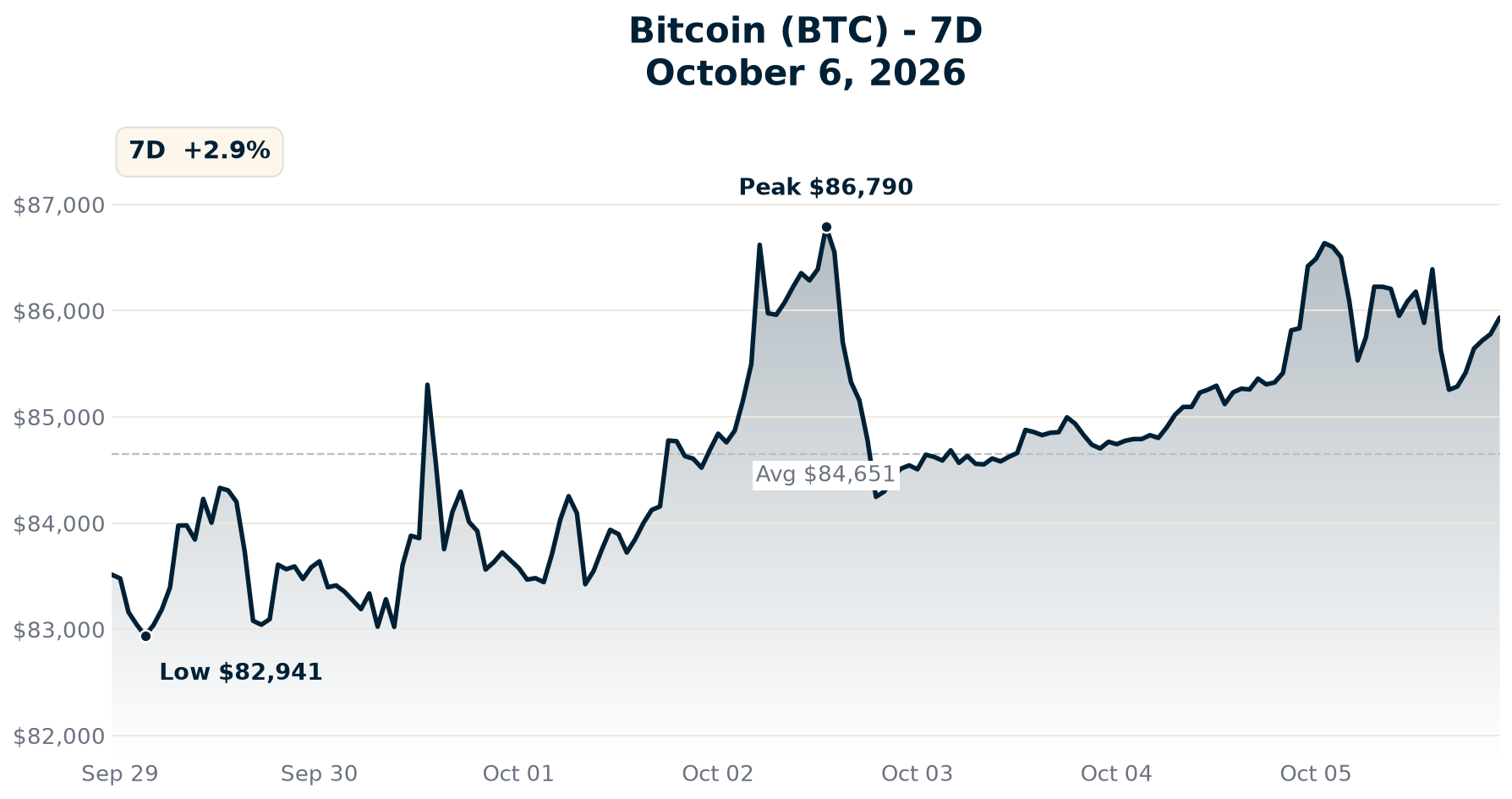
- Opened the week at US$83,514, dipped to a weekly low of US$82,941 on Tuesday, September 29, then climbed to a weekly high of US$86,790 on Friday, October 2, presumably as weak U.S. jobs data eased fears of an October Fed rate hike. Bitcoin pulled back later that day, coinciding with a rise in Treasury yields and the U.S. dollar, before rallying over the weekend, and is now trading around US$85,935 (+2.9% 7D).
- BTC dominance ranged between 58.5% and 59.2% this week.
- Bitcoin investment products saw inflows of US$241.1 million.
Bitcoin recorded its best weekly close in eight months at US$86,570 on Sunday, October 4, following a 42.7% gain in the third quarter, its strongest Q3 since 2017. However, bitcoin remains below its 2026 opening price of US$87,570, which traders are watching as a key level of resistance.
Citi raised its 12-month bitcoin price target to US$113,000 from US$82,000, and its Ethereum target to US$3,028 from US$2,240, citing exchange-traded fund (ETF) inflows, a supportive macro backdrop and U.S. Securities and Exchange Commission (SEC) rulemaking. The bank expects around US$5 billion of inflows into crypto over the next 12 months.
In bitcoin buying (and selling) news:
- Strategy bought 334 bitcoin (US$28.7 million), bringing its holdings to a record 848,000 BTC (over US$72 billion) at an average purchase price of US$75,441 per bitcoin. The company also spent US$176.3 million buying back its STRC preferred shares.
- Strive bought 2,000 bitcoin (US$169 million), its largest purchase since June, bringing its holdings to 29,462 BTC (US$2.5 billion).
- Metaplanet sold 10,000 bitcoin and later bought back 11,000 during the third quarter, a round trip the company said was designed to show credit rating agencies its bitcoin can be converted to cash to meet obligations. The Tokyo-listed company now holds 44,000 BTC.
Past performance is not a reliable indicator of future results.
Ethereum (ETH)
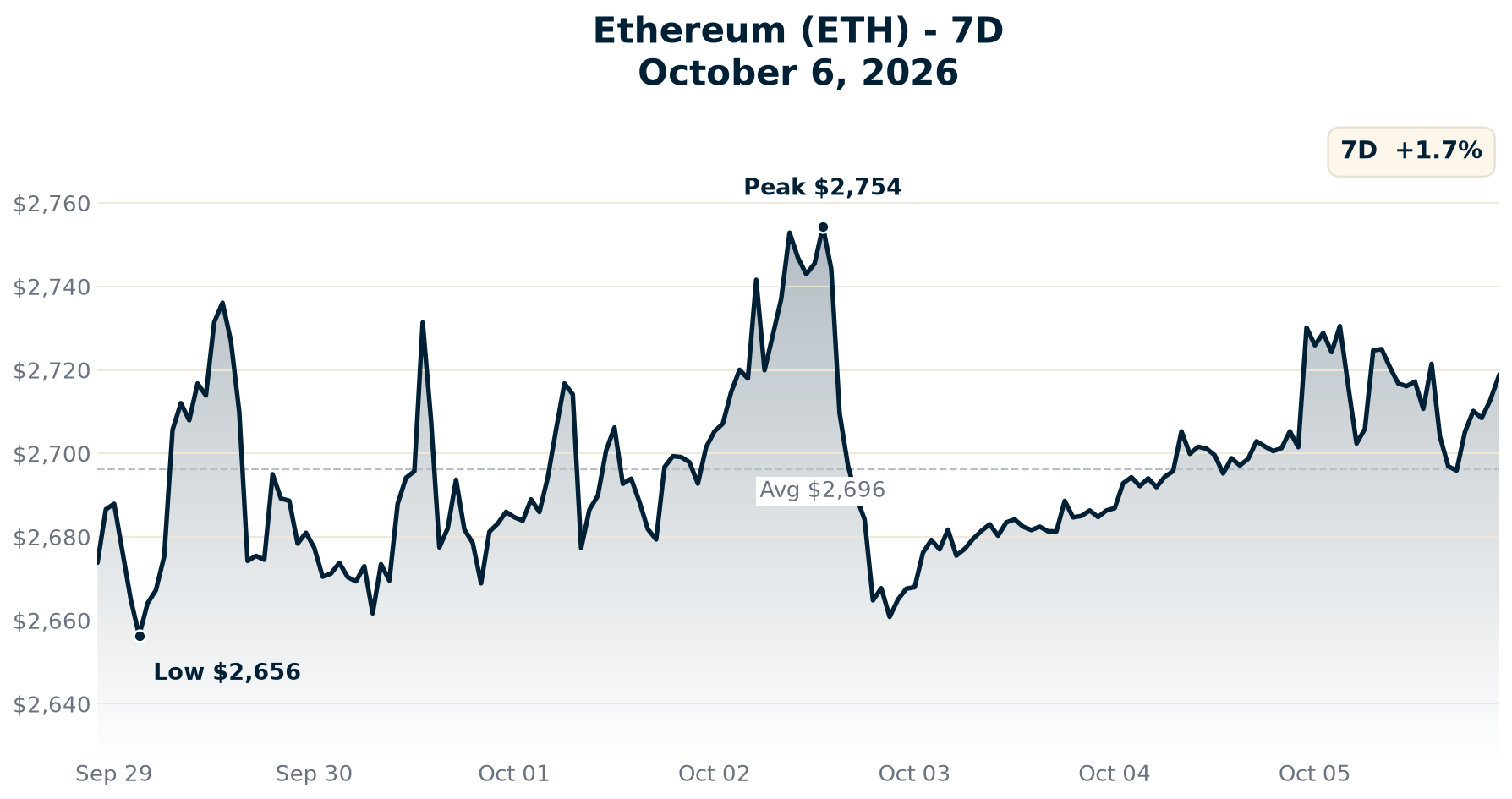
- Opened the week at US$2,674, dipped to a weekly low of US$2,656 on Tuesday, September 29, then climbed to a weekly high of US$2,754 on Friday, October 2, before retreating later that day. Ethereum recovered over the weekend and is now trading around US$2,719 (+1.7% 7D).
- Ethereum dominance ranged between 11.3% and 11.6% this week.
- Ethereum-focused funds saw outflows of US$138.1 million.
MetaMask disclosed an ongoing security incident affecting part of its staking infrastructure and began exiting the Ethereum validators it runs on Lido as a precaution, saying wallets and customer funds are unaffected. According to on-chain researchers, around 17,000 validators holding roughly 523,000 ETH are exiting, which pushed Ethereum's validator exit queue to around 851,000 ETH. Lido says stETH holders do not need to take any action.
Ethereum's next upgrade, Glamsterdam, is scheduled to activate on the Sepolia testnet today, October 6. The upgrade introduces enshrined proposer-builder separation, block-level access lists and gas repricing. No mainnet date has been set.
In Ethereum buying news:
- BitMine bought 15,112 ETH (US$41 million). The company now holds over 6 million ETH, worth US$16.3 billion, or around 4.9% of supply.
Past performance is not a reliable indicator of future results.
Altcoins
The altcoin season index is currently 62, which is leaning toward altcoin season, though a broad-based rally across crypto is not present.
Seoul searching
- The Sandbox gained 62.6%. The blockchain-based virtual world, where users own land, build games and trade digital assets, surged after South Korean exchanges Upbit, Bithumb and Coinone lifted trading warnings on SAND, which were put in place after an August bridge exploit. Fellow metaverse tokens Decentraland and Axie Infinity gained 19.2% and 18.1%, respectively, presumably in sympathy.
Touch grass
- Grass gained 34.5%. The decentralised network that pays users to share unused internet bandwidth, which it uses to gather public web data for AI labs, rallied after Multicoin Capital announced an investment in the project. Multicoin said Grass earned US$17 million in revenue in the first half of 2026, matching its full-year 2025 total.
Stacking up
- Stacks gained 20.1%. The bitcoin layer-2 that brings smart contracts and decentralised finance (DeFi) to Bitcoin jumped after Stacks Labs announced that founder Muneeb Ali will return as CEO on October 15, around five years after stepping back.
Feel the burn
- Aave gained 25.2%. The largest decentralised lending protocol rallied after founder Stani Kulechov said Aave is considering burning the tokens it buys back under its US$50 million-a-year buyback program, rather than holding them in its treasury. Deposits on its new V4 markets also passed US$1 billion.
- PUMP gained 27.6%. The native token of the Solana-based memecoin launchpad rallied as the platform's revenue-funded buyback-and-burn program passed US$466 million, retiring almost 17% of the token's supply. The platform's 30-day revenue of US$55.5 million also edged past Hyperliquid's US$54.3 million.
Terminal velocity
- Hyperliquid gained 8.2%. The decentralised perpetual futures exchange directed around 90% of the yield earned on its USDC reserves to HYPE buybacks, with a first payment of around US$14.6 million. Bloomberg also added live Hyperliquid perpetual prices to its Terminal, while the team's 3.75 million HYPE unlock was reportedly sold over the counter to a single institutional buyer rather than on open markets.
Crypto ETF News
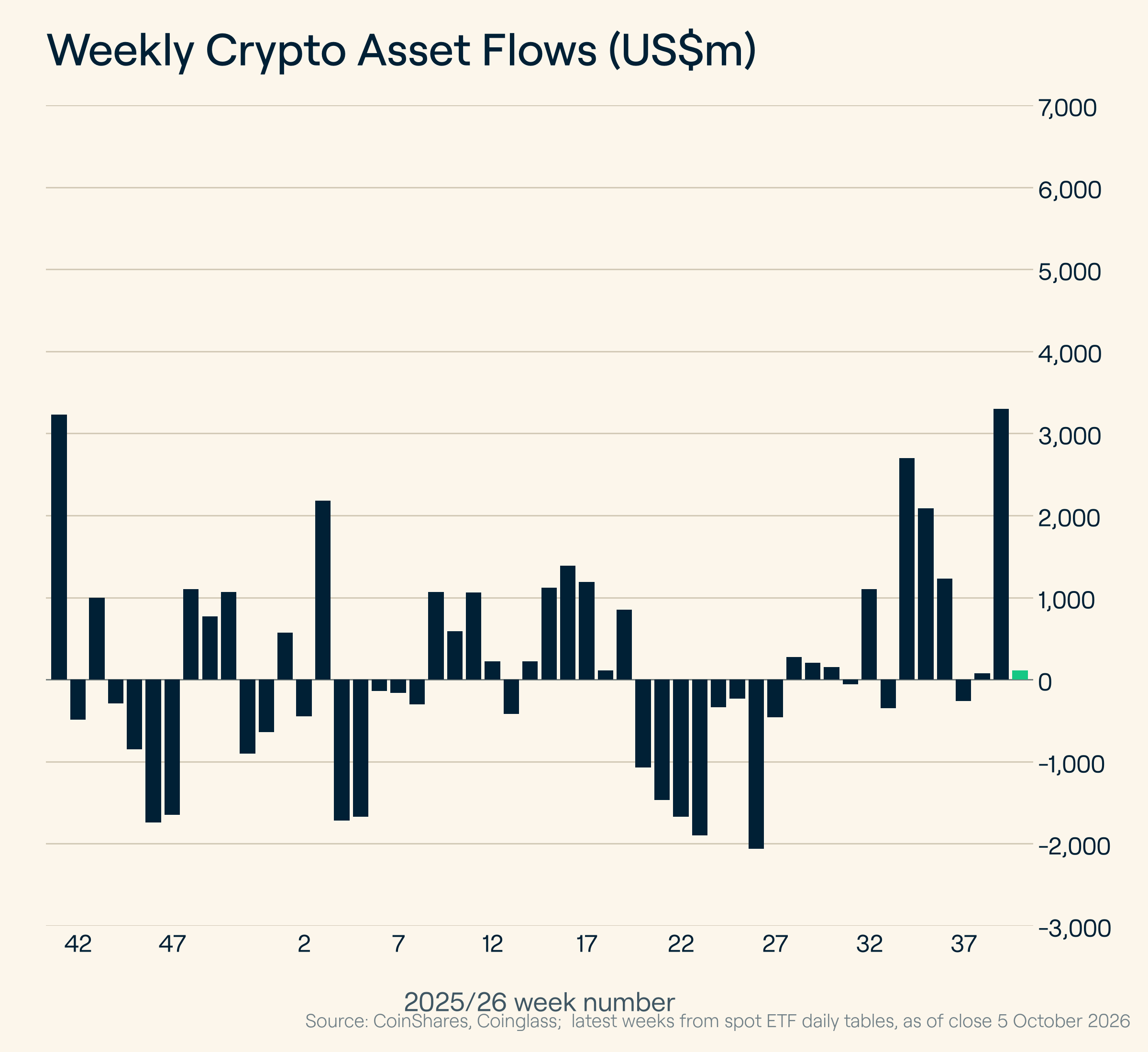
Digital asset investment products saw inflows of US$112 million this week, a sharp slowdown from the previous week's US$3.3 billion. Bitcoin funds recorded a third consecutive week of inflows, while Ethereum-focused funds saw outflows, presumably as rising Treasury yields weighed on investor sentiment.
In altcoins, XRP, Solana and HYPE saw inflows of US$4.8 million, US$800,000 and US$3.4 million, respectively.
Bitwise launched the first U.S. spot NEAR ETF on NYSE Arca under the ticker NRR, with the fund staking its NEAR holdings. Separately, the U.S. SEC cleared Cboe to list six 3x leveraged funds tracking bitcoin, Ethereum, gold, silver, crude oil and natural gas futures.
Past performance is not a reliable indicator of future results.
Other crypto news
- The Commodity Futures Trading Commission (CFTC) unveiled a plan to bring crypto exchanges under federal oversight using its existing powers, without waiting for Congress. The proposed framework would cover crypto trades involving leverage, margin or financing, and creates a new "crypto asset market" registration with listing standards and proof-of-reserves requirements. Spot trading without leverage would remain under state regulation. The proposal is open for a 60-day public comment period.
- The U.S. Treasury's Financial Crimes Enforcement Network (FinCEN) withdrew two proposed rules targeting crypto: a 2020 proposal requiring banks and money services businesses to keep records of transactions with self-custody wallets above US$3,000, and a 2023 proposal targeting crypto mixers. FinCEN cited a possible "chilling effect on legitimate activity".
- The U.S. SEC proposed custody rules for crypto held by investment advisers and funds. The framework would permit self-custody in certain circumstances and allow state trust companies to act as custodians. The proposal is open for a 60-day public comment period. Separately, SEC Commissioner Hester Peirce, who has led the agency's Crypto Task Force since 2025, stepped down on October 2, leaving the SEC with two commissioners.
- OKX and Intercontinental Exchange (ICE), owner of the New York Stock Exchange, filed to launch 24/7 trading of tokenised U.S. stocks through their joint venture under the SEC's Innovation Exemption. More than 60 stocks, including Nvidia, Tesla and Apple, would trade against the USDC, USDG and USDT stablecoins.
- Robinhood announced perpetual futures for U.S. customers with up to 10x leverage on bitcoin and Ethereum, alongside AI trading agents that can research and place trades on behalf of customers, and 24/7 trading in selected stocks and ETFs.
- Stripe expects to offer stablecoin card programs in more than 100 countries by the end of the year. Separately, Lloyds and Visa settled US$750,000 in USDC in a live cross-border pilot, with each settlement taking less than an hour.
- Evernorth, which expects to hold around 473 million XRP, is expected to begin trading on Nasdaq under the ticker XRPN on October 8, after shareholders approved its SPAC merger. Backed by Ripple, Pantera and Kraken, it will be the largest publicly traded pure-play XRP treasury company.
- Blockchain analytics firm Chainalysis attributed the US$387.5 million Bitget hack to North Korea-linked hackers, pushing North Korea's crypto thefts this year past US$1 billion. Bitget has since restored all withdrawals. Crypto hacks totalled around US$766 million in September, the highest monthly total of 2026.
from Caleb & Brown Cryptocurrency Brokerage.


