


Market highlights
- Democrats won both chambers of Congress, and Elizabeth Warren is set to chair Senate Banking.
- Bitcoin fell to its lowest since August as an AI stock sell-off and hot U.S. inflation erased its gains.
- Bitcoin miner MARA sold 13,597 bitcoin to fully repay US$750 million of bitcoin-backed loans.
- The NYSE picked Avalanche technology to settle trades on its planned tokenised stock venue.
- The OCC granted Coinbase a full national trust charter.
- The Department of Labor sent its final 401(k) crypto rule to the White House for review.
Macro market overview
U.S. markets ended lower as a sell-off in artificial intelligence (AI) stocks erased a rally that followed the midterm elections, with the S&P 500 and Nasdaq falling for a fourth straight week. The Dow Jones jumped 3% after Democrats won control of both chambers of Congress, its best day since April 2025. The next day the S&P 500 fell 4.4%, its worst day since the April 2025 tariff sell-off, and Nvidia dropped 9.3% amid worries that data centre construction could slow. Chip stocks rebounded at the start of the new week, lifting the S&P 500 2.3%.
U.S. employers added 165,000 jobs in October, well above a forecast 65,000, and the unemployment rate fell to 4.1%. Cleveland Fed President Beth Hammack called for a move to a restrictive stance, while Richmond Fed President Thomas Barkin backed gradual rate increases. The 10-year Treasury yield ended the week at 4.86%, down from 4.94%. On Tuesday, U.S. consumer prices rose 0.4% in October, above a forecast 0.3%, while core prices rose 0.3% against a forecast 0.2%. Fed Governor Christopher Waller backed a December rate hike and said a larger half-point move could be warranted, and the 10-year yield climbed back to about 5%. After the data, CME's FedWatch tool put the likelihood of a rate hike at the Fed's December 9 meeting at 100%, including a 15% chance of a half-point hike.
Oil prices fell sharply, presumably on hopes of de-escalation with Iran after the election. West Texas Intermediate crude ended the week almost 13% lower at US$90.83 a barrel, and Brent fell a further 5.9% to US$92.57 in the new week, though Secretary of State Marco Rubio dismissed Iran's demands. Elsewhere, the Bank of England raised Bank Rate by 25 basis points to 4% in an 8–1 vote, its first increase in three years.
Looking ahead, the new Democratic majorities take control of both chambers of Congress in January, which could reshape the path for U.S. crypto legislation in 2027.
Weekly performance: S&P 500 -2.7%, Dow Jones -0.9%, Nasdaq -3.4%.
Looking ahead:
- U.S. PPI - Friday, November 13
- Nvidia earnings - Tuesday, November 17
- U.S. FOMC meeting minutes - Wednesday, November 18
Crypto Market Performance
Market Cap: $2.47T (-5.8% 7D)
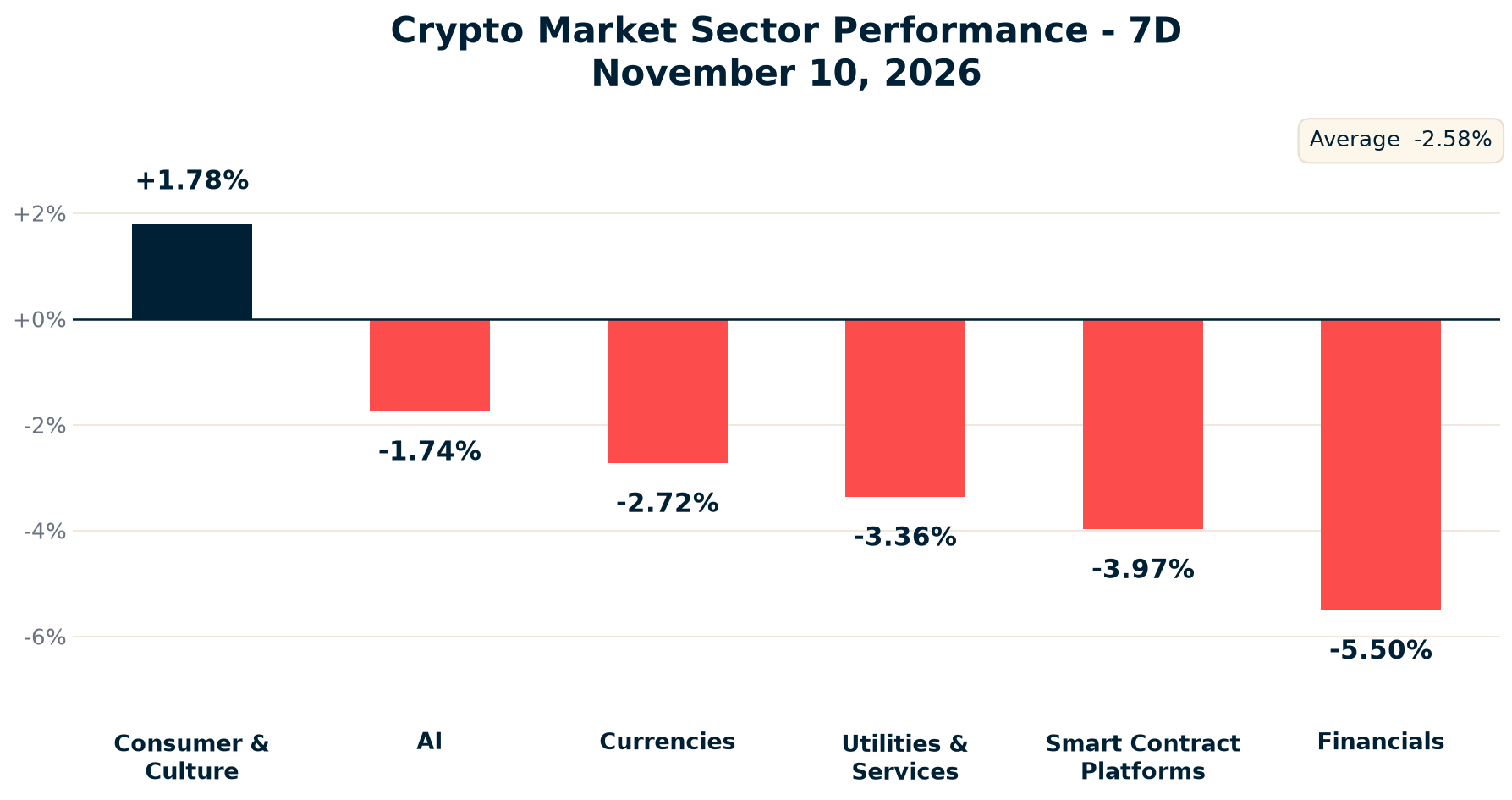
Five of six crypto sectors declined this week, coinciding with the sell-off in AI-linked stocks. Consumer and culture led with a 1.8% gain, followed by AI, which slipped 1.7%, while financials lagged with a 5.5% decline. The crypto fear and greed index remains in "fear" at 26, down from 35 a week ago.
Past performance is not a reliable indicator of future results.
Bitcoin (BTC)
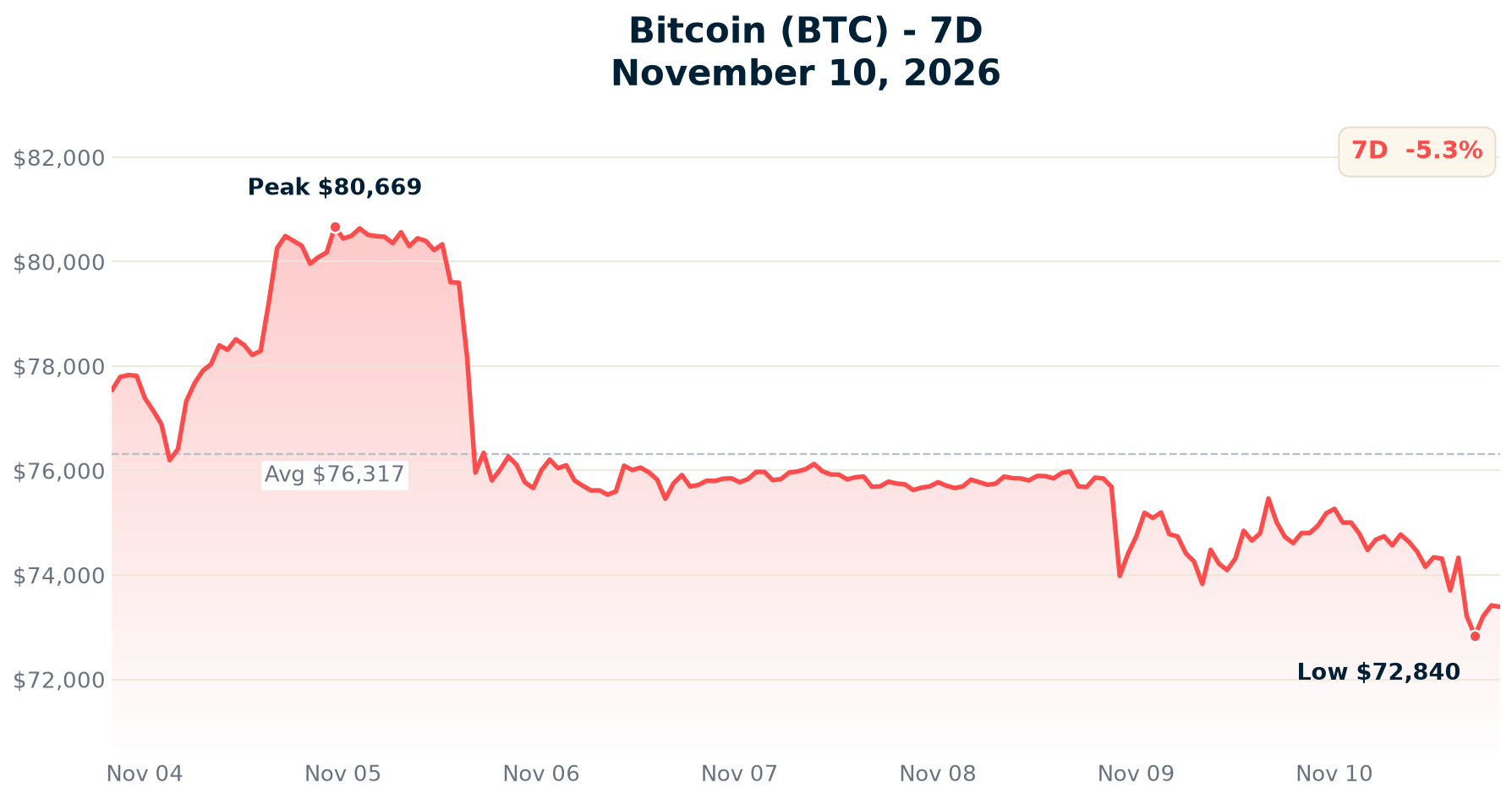
- Opened the week at US$77,536, climbed to a weekly high of US$80,669 on Wednesday, November 4 after the midterm elections, then fell as an AI-led sell-off hit U.S. stocks. Bitcoin dropped to a weekly low of US$72,840 on Tuesday, November 10, its lowest since August, after hotter-than-expected U.S. inflation data, and is now trading around US$73,390 (-5.3% 7D).
- BTC dominance ranged between 59.7% and 60.4% this week.
- Bitcoin investment products saw outflows of US$1.28 billion, their largest weekly outflow since June.
More than US$1 billion of leveraged crypto positions was liquidated on November 5 as bitcoin fell about 6% in a day, as the sell-off in technology stocks spread to crypto. Bitcoin slid again over the weekend, then fell below US$73,000 on Tuesday, its lowest level since August, after hotter-than-expected U.S. inflation data raised bets on a larger Fed rate hike in December.
Wallets labelled as collateral for Trump Media's convertible notes moved 4,259 BTC, worth about US$342 million, to an address reportedly belonging to a crypto exchange. The transfer comes weeks before noteholders can demand about US$1 billion in repayment on November 30, potentially signalling a sale, though none has been confirmed.
In bitcoin buying (and selling) news:
- Strategy bought 1,036 bitcoin (US$81.9 million), bringing its holdings to 850,364 BTC (about US$62 billion) at an average purchase price of US$75,456 per bitcoin. The company also spent US$188.3 million buying back its STRC preferred shares.
- MARA sold 13,597 bitcoin (about US$1.1 billion) after the end of the third quarter and used the proceeds to fully repay US$750 million of bitcoin-backed loans, as the miner shifts towards AI infrastructure. It held 34,012 BTC at the end of September, before the sale.
- Strive bought 29 bitcoin, bringing its holdings to 43,153 BTC (about US$3.2 billion).
Past performance is not a reliable indicator of future results.
Ethereum (ETH)
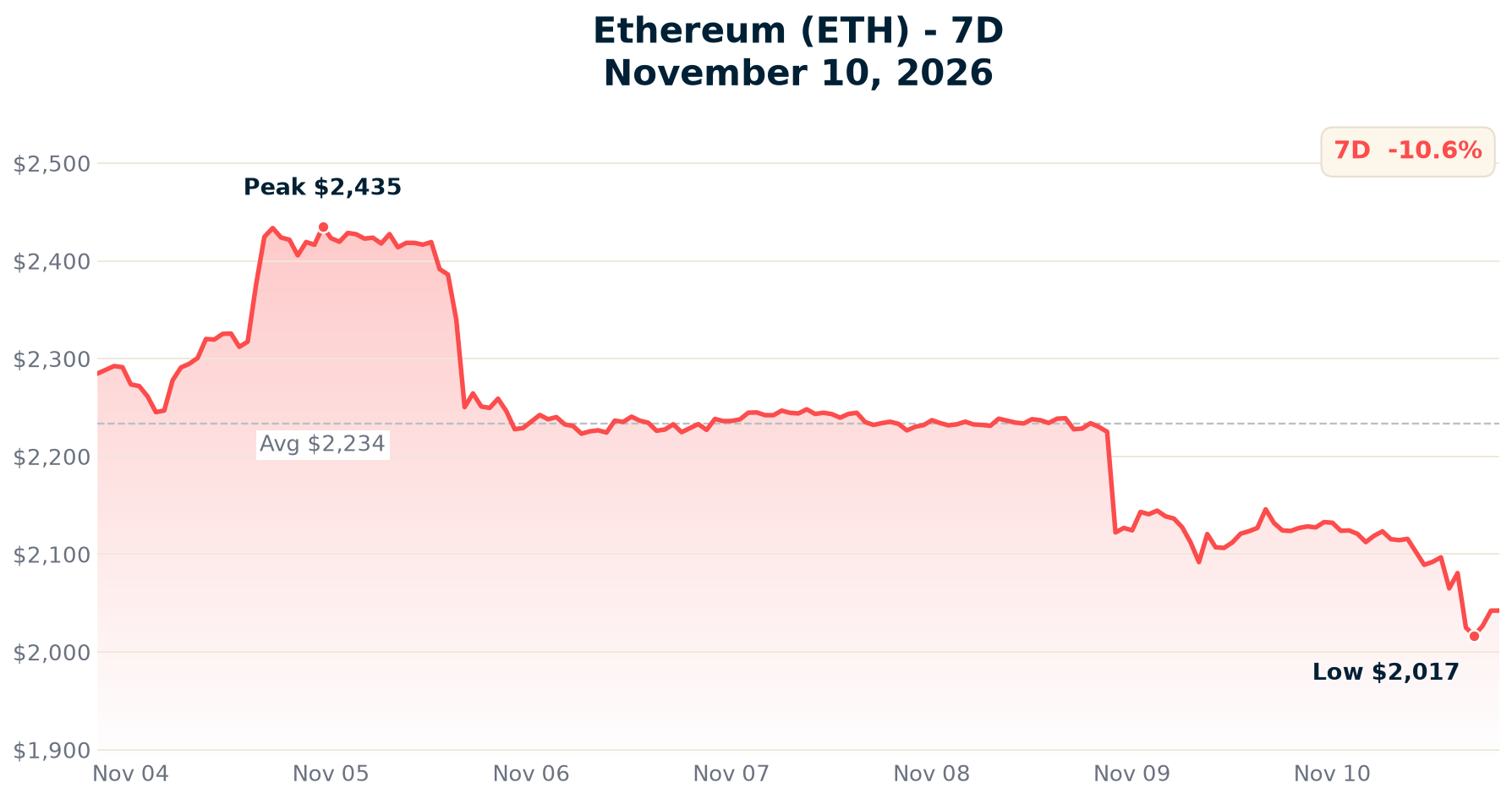
- Opened the week at US$2,285, reached a weekly high of US$2,435 on Wednesday, November 4, then declined with the wider market to a weekly low of US$2,017 on Tuesday, November 10. Ethereum is now trading around US$2,042 (-10.6% 7D).
- Ethereum dominance ranged between 10.1% and 11.0% this week.
- Ethereum-focused funds saw outflows of US$365.2 million.
Ethereum co-founder Vitalik Buterin moved on from the "ultrasound money" idea, saying ETH's value comes from its stability as a store of value rather than from the network's fee burn, which he called "never a true floor". The idea, popular since 2021, held that burning fees would shrink ETH's supply over time.
In Ethereum buying news:
- BitMine bought 9,587 ETH (about US$20 million). The company now holds over 6 million ETH, worth about US$12.4 billion, or almost 5% of supply.
Past performance is not a reliable indicator of future results.
Altcoins
The altcoin season index is currently 41, which is near the midway point between bitcoin and altcoin season, though still weighted toward bitcoin season.
Staking a claim
- Injective gained 11.0%. The layer-1 blockchain built for trading and financial applications rallied after Canary Capital's staked Injective exchange-traded fund (ETF) began trading on Nasdaq under the ticker INJC on November 5. The fund stakes its INJ to earn additional tokens for investors, and two more INJ ETFs, from 21Shares and REX-Osprey, are awaiting approval.
Avalanche x NYSE
- Avalanche declined by 3.2%, despite rising about 8% in a day on November 9, after the New York Stock Exchange (NYSE) picked Avalanche technology as the core ledger for clearing and settling trades on its planned tokenised stock platform. The NYSE will run its own blockchain built on Avalanche's technology rather than the public network, and the round-the-clock venue is subject to regulatory approval.
No TRUMP card
- Official Trump declined by 28.2%. The memecoin linked to President Donald Trump fell 17% in a day after Democrats won control of both the House and the Senate in the U.S. midterm elections on November 3. It hit an all-time low on November 5, when a sell-off in technology stocks spread to crypto, and fell to a new low on November 9.
Crypto ETF News
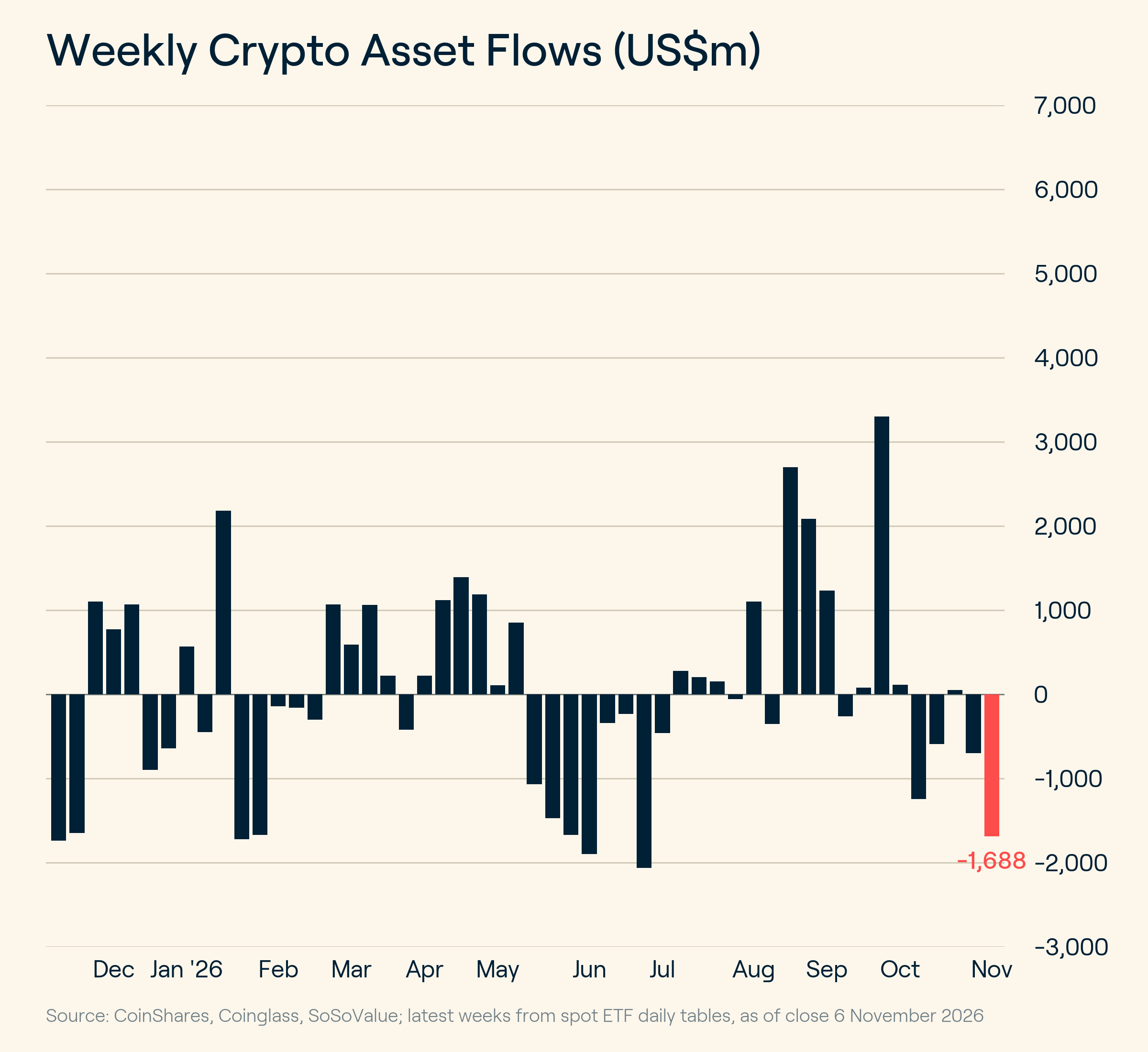
Digital asset investment products saw outflows of US$1.69 billion for the week, as US$1.28 billion left bitcoin funds in their largest weekly outflow since June, turning their 2026 flows negative.
In altcoins, XRP, Solana and HYPE saw outflows of US$529,500, US$25 million and US$15.7 million, respectively.
Past performance is not a reliable indicator of future results.
Other crypto news
- Democrats won control of both chambers of Congress in the November 3 midterm elections, and Senator Elizabeth Warren is set to chair the Senate Banking Committee from January, with plans to scrutinise prediction markets and crypto ventures linked to the Trump family. The CLARITY Act, stalled in the Senate since a 49–50 vote on September 15, may not survive in its current form after the Democratic sweep, and any new market structure bill would have to pass through committees led by Democrats.
- Coinbase received a full national trust charter from the Office of the Comptroller of the Currency (OCC), upgrading the conditional approval it received in April. Ripple received its final approval in October, and a community bank group is challenging the OCC's crypto trust charters in court.
- The Department of Labor sent its final rule to the White House for review on November 5. The rule would let 401(k) retirement plans offer alternative assets, including crypto, implementing an executive order from President Trump, and can be published once the review is complete.
- The Federal Reserve and the U.S. Treasury's Financial Crimes Enforcement Network withdrew a 2020 proposal that would have lowered the threshold for record-keeping and travel-rule checks on cross-border transfers, including crypto, to US$250 from US$3,000. The agencies want any future rule to fit how the industry works today, after the Treasury withdrew separate proposals on self-hosted wallets and crypto mixing in October.
- The Commodity Futures Trading Commission (CFTC) told prediction market exchanges such as Kalshi and Polymarket that they may not block users by state and must reopen closed regions within 30 days or explain why, setting up a clash with court orders that require Kalshi to block users in some states. Senator Adam Schiff accused the agency of trying to undermine state law.
- PNC Bank began a pilot that lets eligible corporate and institutional clients receive payments in the USDC stablecoin, converted one-for-one into U.S. dollars in their PNC accounts, using Coinbase's payment technology.
- Visa added the Monad blockchain network to its stablecoin settlement program, so participating card issuers and payment processors can settle with Visa through Monad. It joins networks such as Ethereum, Solana and Avalanche, and Visa reported an annualised stablecoin settlement run rate of US$20 billion in September, more than 15 times a year earlier.
- Goldman Sachs, Citigroup, Santander, Deutsche Bank and other large banks have reportedly committed about US$270 million to Project Faro, a joint stablecoin company that plans to issue stablecoins in the euro and other major currencies.
Inside the Markets
Crypto fell harder than stocks in October as spot ETF demand reversed, AI stocks sold off and Binance suffered a record hack. Bitcoin closed the month down 7.3%.
We examine what drove October's sell-off, from the AI rout to the Binance hack, and the key catalysts for November.

from Caleb & Brown Cryptocurrency Brokerage.


